
Rockley Was Right. The Line Just Moved.

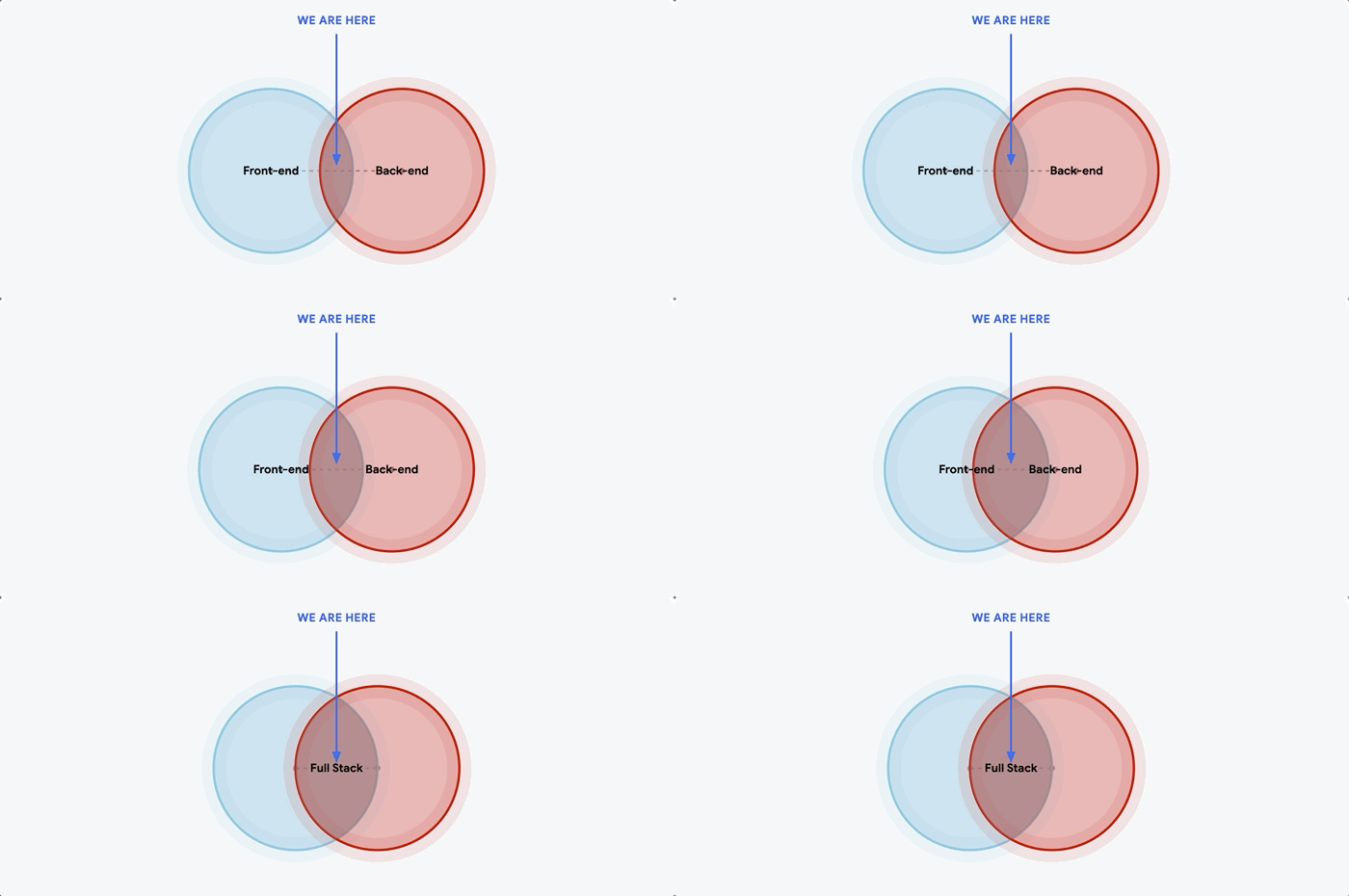
A decade ago, Ann Rockley drew a clean picture of our field: front-end content strategists who love the customer experience, and back-end content strategists (her term: intelligent content strategists) who love structure, scalability, and systems. Two circles, one overlap in the middle called workflow governance.
I referenced that diagram on a panel at Button 2026 and said out loud what I've been thinking for a while: those two circles are closing into one. Content designers no longer have the luxury of staying on the front-end side anymore.
Rockley was ahead of her time
That framing wasn't a snapshot of a temporary state — it was a genuinely useful map for the era it described. It gave practitioners permission to specialize: you could go deep on personas, journeys, and voice, or you could go deep on modularity, metadata, and reuse, and either one was a legitimate, valuable path.
The tradeoff is that a clean map also draws a clean line. For some practitioners — myself included, earlier in my career — the back end could feel like someone else's domain, something to hand off rather than something to understand.
Then a lot of orgs tried skipping the front end entirely
Somewhere in the last couple of years, a chunk of organizations took the AI moment as license to dismantle their content teams outright, on the theory that a model could just do the writing. Call it the FA stage of FAFO — the "f-around" part, where the experiment looks cheap, and the case for keeping content people around suddenly looks weak on a spreadsheet.
Now those same orgs are hitting the FO stage. The writing is technically present, but nobody owns whether it's right, consistent, safe, or actually usable at scale — because generating a string and governing a body of content are two different jobs, and only one of them was automated away. Turns out the people doing that second job were never the bottleneck. They were the reason the first job kept working.
What's forcing the two circles together
AI-generated and AI-assisted content doesn't respect the old boundary. A model pulling from your content doesn't know or care whether a given decision was labeled "front-end" (what should this say) or "back-end" (how is this structured, tagged, and governed) — it just executes on whatever's been decided, or wasn't.
Structure without voice risks systems that talk to customers with no editorial layer behind them. Voice without structure risks content a model can't reliably retrieve or reuse.
The overlap Rockley drew in the middle — governance — isn't a shared sliver anymore. It's most of the job. We're not front-end or back-end anymore. We're full-stack.
What this looks like in practice
A few signs your own practice is already living in the merged circle, whether or not you've named it:
You're being asked to define voice and structure in the same conversation — not as two separate requests handed off at different stages
Your product and engineering partners no longer distinguish between "how the content is structured" and "what the content strategy is" — to them, it's one conversation
You can no longer hand off structural or technical content questions as "not your job" — they directly determine what a model does with your content
Reviewing a piece of content now means asking how it holds up when pulled out and recombined elsewhere — not just how it reads start to finish
The takeaway
This isn't a loss of craft — it's an expansion of it. The organizations currently in the FO stage aren't discovering that content design doesn't matter. They're discovering that it mattered on both sides of Rockley's diagram all along, and they only staffed for one.


Comments